

How To Clean Oil From Concrete Crc Electric Lean
 Stains on Brick Surfaces
How to identify, clean, or prevent stains on brick surfaces, chimneys, walls, floors & on physical block surfaces
- POST a QUESTION or COMMENT about the cause, removal or prevention of staining on brick surfaces
InspectAPedia tolerates no conflicts of interest. We have no relationship with advertisers, products, or services discussed at this website.
Stains & discoloration on brick surfaces:
This article describes the causes & cures for various types of stains found on brick surfaces both outdoors and indoors. We list the common sources of stains on brick chimneys, walls, walks, and ceilings.
The commodity distinguishes among common brick stain sources such every bit algae, bacteria, lichens, moss, soot, sulphur, fungal growth, and other causes of markings on brick.
Nosotros too provide an Article INDEX for this topic, or you can effort the page top or bottom SEARCH BOX as a quick way to observe information you need.
Stains on Brick Surfaces
Article Contents
- STAINS on BRICK SURFACES
- BRICK CHIMNEY STAINS
- BRICK EXTERIOR WALL STAINS
- Blackness STAINS on BRICK
- GREEN STAINS on BRICK - ALGAE
- RED STAINS on BRICK - RUST?
- WHITE STAINS on BRICK
- BRICK EXTERIOR CLEANING WARNINGS
- BRICK Exterior PATIO / WALK STAINS
- BRICK INTERIOR WALL STAINS
- BRICK SURFACE PAINT REMOVAL
- BRICK STAIN REMOVAL GUIDES
[Click to enlarge whatsoever image]
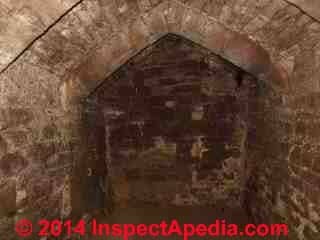
Photo above, brick (and stone) staining in the dungeon at Goodrich Castle, Ross on Wye, Herefordshire, England, United kingdom of great britain and northern ireland.
Brick Chimney Stains
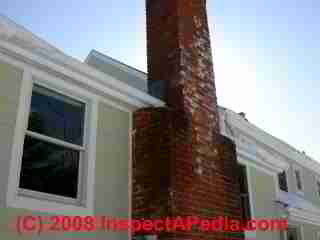
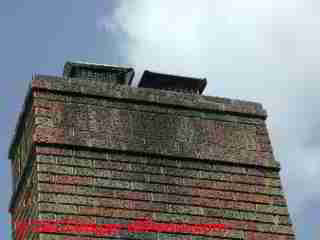
Beneath our photograph at left shows white gunk on the exterior surface of a chimney.
This is almost certainly efflorescence, a mineral salt left behind equally water leaks into and evaporates out of the brick chimney. The right-hand photo shows blackness soot staining at the top and sides of a brick chimney. If this soot is from an oil fired heating appliance, a service call is needed.
[Click to enlarge any image]
See EFFLORESCENCE SALTS & WHITE DEPOSITS for steps to cure efflorescence and to remove information technology from brick or other masonry surfaces.
Beneath we run into blackness or brownish tarry stains on the surface of a chimney visible in an attic. These are nigh probable creosote, or creosote mixed with soot that has leaked through openings in this antique brick chimney and its flue. We discuss this chimney and what to practice near information technology
at CHIMNEY STAINS, INDOORS
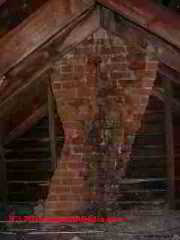
See CHIMNEY STAINS & LEAKS for a catalog of stains appearing on, in or around all types of chimneys.
Watch out: h2o impairment or soot, creosote, or other blockages of chimneys may brand the chimney or flue unsafe.
Come across CHIMNEY INSPECTION DIAGNOSIS REPAIR
Stains on Brick Exterior Walls
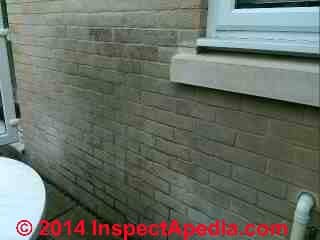
Black, night, or greenish stains on outside brick
A reader asked united states of america for an opinion of the crusade of the green and black stains on this exterior brick building wall.
While a closer on-site inspection or in some cases a forensic lab analysis of a tape lift of the brick wall surface would be needed for certain identification, this looks much like blackness and green algae growing on the wall surface.
The reader noted that the nighttime staining on this brick was occurring only below an surface area where roof drainage was spilling down the building wall, and s/he asked for advice virtually how to clean this surface, and whether ability-washing would be ok.
To minimize the chances of damage, we like to commencement cleaning with the most gentle approach kickoff to run across if that's sufficient.
Power washing may be OK on this modern difficult-fired clay brick wall as long as the washer does not spray h2o into the wall cavity through weep holes or other openings.
More black stains on an exterior brick wall are shown just below. These are due to rain-splash-up from the lower roof onto the brick sidewall. The increased moisture level has encouraged algal growth on the brick surface.
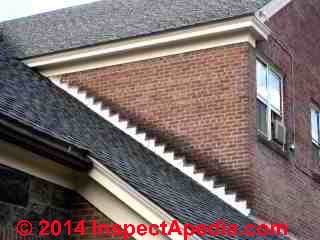
Green Stains on Outside Brick Walls: Algae
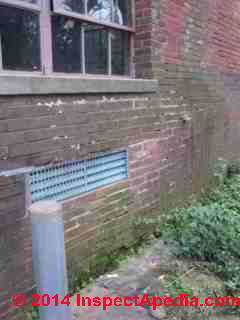
Above the green stains on this structural brick wall (Vassar Higher, Poughkeepsie, New York, United states) are nigh certainly an algae growth.
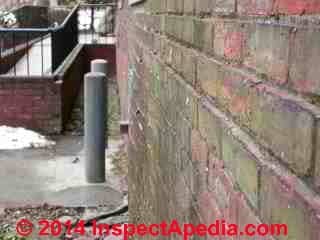
The wall is shaded and roof drainage arrangement leaks have fabricated this wall side specially wet. Later, afterwards the roof drainage system had been repaired, this wall was renovated and portions of it that had been frost-damaged were re-built.
Common Causes of Green Stains on Brick Surfaces
- Algae, Lichens, Moss on brick
- Green paint on brick: identify as pant from nearby surfaces or edifice history
- Vanadium salt staining on brick: vanadium salts combined with acidic environments that may in turn be due to use of muriatic acid or HCL to make clean brick surfaces or in areas of acid rain can go out light-green crystalline salts on the brick surface. Stain may exist chartreuse in colour, greenish, or yellowish-green.
Remove vanadium green stains: using chemic cleaners such equally VanGo, Oxcid (followed by a neutralizing amanuensis such as Neutril) IF the staining was not due to apply of an acidic cleaner as we mention above;
Wallkleen may too work.
Light amplification by stimulated emission of radiation cleaning of moulds and rusts and oxides tin can work on artifacts but may not be price-constructive for buildings.
Oxcid or Vital Oxide cleaner, various sources [citations needed]
VanGo, from ATCO International, 1401 Barclay Circumvolve, SE Marietta, Georgia 30060-2925 produces a series of cleaners and paint and graffiti removers. 1-800-723-2826 Website: https://world wide web.atcointernational.com/prod-22-1-663-24/vango-2.htm
Walkleen, from Sanosil, agile cream cleaner, is an acidic facade cleaner. Sanosil A.G., Eichtalstrasse 49 CH-8634 Hombrechtikon Website https://www.sanosil.com/en/produkte/wallclean-southward-fassadenreiniger-sauer/ excerpt:
Sanosil WallClean S is a powerful special active cream cleaner for pre-treating or cleaning façade surfaces infested with mould, algae or moss. Sanosil WallClean S does non contain whatever fungicides and is completely biodegradable in accordance with European directive 73/404/EEC relating to detergents and directive 73/405/EEC on biodegradability testing.
Sanosil WallClean S effectively removes oil and grease, limescale, wax remainder, algae and plant components, and soiling (mud, grit etc.). Specially suitable for utilize as an active foam in conjunction with low-force per unit area foam applicators.
Question: why is my brick wall mortar turning light-green & what tin can I do nearly information technology
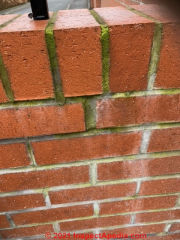
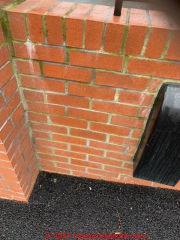
Can you please advise what I should practice about my new garden wall? The mortar is starting to turn green. - Anonymous by private email 2022/03/31
Moderator reply: how to make clean & prevent algae growth on brick walls
The green in your photos is almost certainly algae, though there could be some mold growing at that place too. The algae growth occurs "naturally" outdoors on wet masonry (and other surfaces), peculiarly in a damp or wet climate and more-and so where shaded from dominicus exposure.
You can make clean the algae using any of several cleaners that are discussed
at BRICK STAIN REMOVAL GUIDES
and also
at STONE, STUCCO & BRICK CLEANING METHODS - where there are likewise some prevention suggestions.
Besides see ALGAE & MOLD STAINS on EXTERIORS
A competent onsite inspection by an adept commonly finds additional clues that would let a more than accurate, complete, and authoritative answer than we can requite past email lonely. You will find additional depth and detail in articles at this website.
Red Stains on Brick: Rust?
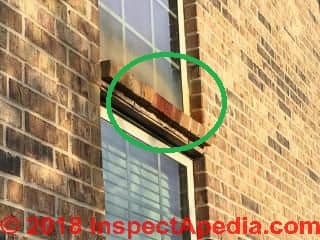 On 2022-09-16 1 by (mod) - diagnose and remove red stains on brick window sill
Mahmood
Regarding the nighttime red stains on the center of the brick window sill in your photo:
My best guess is that previously someone had a window air conditioner in the window in your photo and the A/C condensate rusted the air conditioner base and stained the brick equally it drooled downward the building wall.
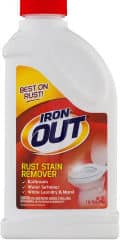
If the red stains on the brick sill are from rust, endeavor an iron or rust stain remover product.
The article STAINS on BRICK SURFACES discusses approaches to cleaning stains on brick likewise as preventing their recurrence.
If the red stains on the brick sill in your photo are algae (which seems less likely given the circumstances portrayed in your photo, but notwithstanding, not impossible), simply well-nigh any household cleaner may remove it; use plenty of rinse water to avoid whatever bleach staining of the bricks below.
Sources of Ruddy Stains in or on Brick Surfaces (too black & brown)
- Manganese dioxide (MnOtwo) efflorescence: manganese dioxide inclusions in the brick (or mortar) may be dissolved by very soft rainwater or by apply of muriatic acrid (often used to clean mortar from brick surfaces later recent masonry work). The alkaline chemistry of mortar may react with MnOii to form a dark-brown-crimson stain or or sometimes a black stain on brick.
Remove using a dilute acid such as 0.01M Hydrochloric Acid (HCL) and 3% Hydrogen Peroxide H2O2. Rinse thoroughly, promptly to avoid run-down stains.
Cream of tartar + hydrogen peroxide may also work.
- Crimson algae, lichens, mold stains: some algae (and some fungi or lichens) are red in colour; correlate with wet and shade.
Remove from brick using soft brush scrubbing (avert power-washing that may harm brickwork) and any household cleaner or deck cleaner. Rinse thoroughly, promptly to avert run-down stains.
- Rusting metal components or hardware higher up the stain area such as iron window frames, failing galvanized fe flashings, hardware such as shutter bolts or metal fixtures, fifty-fifty iron or bandage-iron piping, railings, etc. above or near the brick surface.
Remove from brick using an fe stain remover product. Rinse thoroughly, promptly to avoid run-down stains.
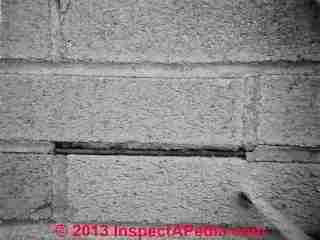
- Rusting metal reinforcement in brick walls and chimneys such as iron wire, mesh, or re-bar too close to the surface of a mortar joint
Remove from brick using an iron stain remover product. Rinse thoroughly, promptly to avoid run-downwards stains. Re-mortar open joints after sealing the exposed metal with a masonry-compatible bonding/agent or sealer or primer.
- Iron sulfide pyrrhotite inclusions in some bricks.
Remove from brick using an iron stain remover product. Rinse thoroughly, promptly to avoid run-downwards stains. Re-mortar open up joints after sealing the exposed metal with a masonry-compatible bonding/agent or sealer or primer. - Doubtful that this will provide long term success. Contaminated brickwork may need to be removed and replaced.
Other brick surface cleaners that might work:
- Paste of dish soap or borax or TSP substitute and salt, ten -xxx minute exposure, rinse thoroughly.
Also run into research on cherry stains on buildings and red stain and iron stain removal suggestions found in these InspectApedia articles
FOUNDATION DAMAGE past Cloth or INCLUSIONS - cherry stains caused by inclusions of iron sulfide mineral (pyrrhotite) can announced in physical and in some brick and stone materials.
RUST STAINS on ROOFS - examples of red rust stains from oxidizing corroding metallic
STAINS on Rock, STUCCO DIAGNOSE & CURE - boosted cleaning methods that can piece of work on brick
WATER SOFTENER IRON & SEDIMENT REMOVAL - more rust stain remover products
Our outer Brick walls few bricks stained along with window drinking glass from outside due continuously dripping of A/C h2o. Kindly advice and assist how to clean stains from bricks and drinking glass.
The photo is shown above.
White Stains on Brick Walls: Efflorescence vs. Paint Pigment Run-downward vs. Mortar SNAFUs
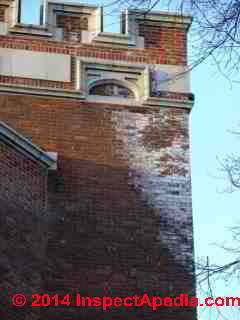
Earlier we illustrated white efflorescence staining on a brick chimney, a common spot where efflorescence appears outdoors on masonry buildings. Our photo at above left, showing thick white deposits on a structural brick wall in New York (Vassar College) shows that efflorescence can show up anywhere that there are water leaks in or downwardly brick walls.
See EFFLORESCENCE SALTS & WHITE DEPOSITS
But not all white stains on brick surfaces are due to efflorescence
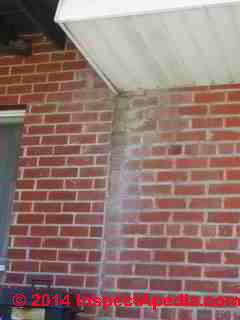
Above the white stains on this brick veneer wall were caused past leaks into the white coated aluminum soffit. White pigment from the soffit has run downwards the wall leaving a white deposit. At that place was a fleck of green algae in the elevation area of this stain too.
Actually? Brick veneer? Yep.
Earlier y'all write to gripe that the small brick-ends indicate a bond class making this a structural brick wall let me explicate that no, this is a brick veneer wall constructed past a retired mason who took delight in making it look like a structural wall. The wall is actually a single wythe brick veneer fastened to a concrete block structural wall.
Below we illustrate another white expanse on a brick wall that is not due to water or leakage nor to paint pigment launder-down. .
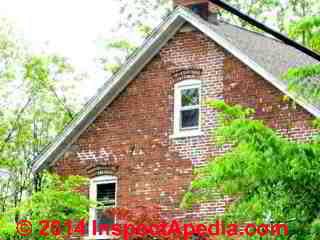
The white "stains" on the brick outside wall shown above are not stains at all but rather mismatched mortar used by a stonemason or an amateur who had little business concern for preserving this pre-1900 home in Dutchess County, New York.
The bricks in this wall were already spalling but the apply of a harder mortar for the repair work is likely to accelerate the spalling damage to this home located in a freezing climate.
Question: are these white stains on brick efflorescence?
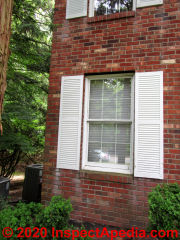 Please see attached picture.
Is this efflorescence?
Is this the issue of run off water from the outside shutters?
I noted that similar staining on brick surfaces on inspectapedia and it was recommended to utilise a TSP (equivalent) cleaning solution would you recommend that here too?
Thinking of recommending professional cleaning.
- Dov Ber Kahn, a habitation inspector in Rockland Canton, NY has contributed photographs of various building features. Mr. Kahn is a licensed home inspector in New York and can be reached at Website: Kahnbhomeinspectors, Tel: 845-445-8234, Electronic mail: kdovber@googlemail.com
Moderator respond: white paint pigment - oxidized paint runs down onto & stains brick veneer
Notice the pattern of white staining is most notable immediately below the edges of those white-painted shutter?
Most-likely it'southward white pigment pigment runoff from the shutters.
There are some whitish bricks that may each exist producing their own personal patch of efflorescence - take a closer await at
Brick wall stain removal by cleaning, ability washing, sand-diggings: warnings
Scout out: Experts like Grimm (1990) widely warn against sand-blasting to make clean brick surfaces of buildings. That aggressive approach damages the brick and mortar and can atomic number 82 to rapid deterioration of the wall.
Furthermore, on antique, soft brick, even ability washing can remove the brick'due south harder-fired surface, leaving the softer brick interior vulnerable to water and frost damage and causing costly building damage.
Ability washing can also remove older soft mortars. And even on the modern hard clay brick wall, the washer needs to be used with care, starting from a more distant position in order to avoid leaving too-lite power-sprayer marks on the wall.
Extra intendance must exist taken if cleaning a brick-veneer wall as there may be more weep openings or leaks around window or door penetrations through which water may be inadvertently sprayed into the wall cavity.
Other brick wall cleaning methods such as using lasers, photocatalytics, or special cleaners are discussed both at
the REFERENCES for this article
and
at STONE, STUCCO & BRICK CLEANING METHODS
Stains on Exterior Brick Floors, Patios, Walks
At below left the black stains on this exterior brick patio located in New York state are probably algae but might as well be a mucus. We'd need to examine a sample in the lab. At below right nosotros see moss growth on the same brick patio in a nearby expanse.
This is a shaded brick patio synthetic in the tardily 1990's. As plantings grew and a shade tree's canopy began to continue more of the patio surface area in shade in summertime months the area covered by algae, moss, and possibly fungi has grown.
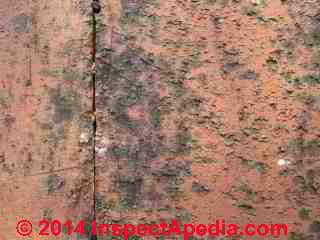
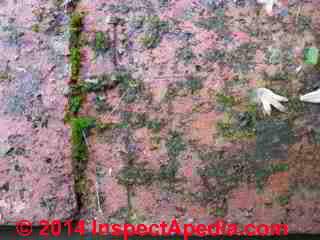
Remedies to reduce the staining on the brick shown above include assuring proper drainage, increasing the sun exposure by judicious pruning, sweeping off organic debris that hold water on the surfaces (leaves), and occasional power-washing.
Watch out: algae and moss on a brick walking surface or on any walking surface for that matter, are very slippery and risk a skid-trip-autumn injury.
See Slippery STAIRS, WALKS, ROOFS for the static coefficient of friction of diverse slippery walking surfaces.
Below we illustrate outdoor brick patio or walk surfaces that are not glace with algae, moss, fungi.
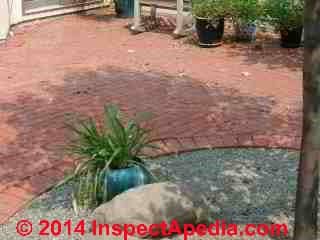
Below we illustrate that a brick walkway, fifty-fifty i congenital using antique bricks that have been in place for more than 50 years do non accept to be slippery with algae, moss, nor fungi. The Dutchess Canton New York brick walkway shown to a higher place is in a sunny expanse and is well tuckered.
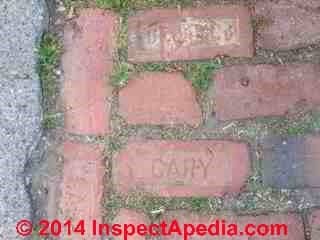
However the property manager does demand to keep alert for frost-heaved or cleaved bricks that might form a trip adventure.
Stains on Interior Brick Wall, Ceiling, or Floor Surfaces
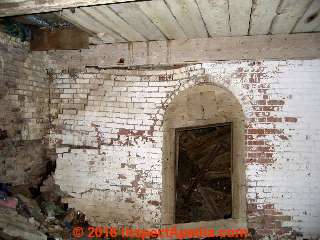
Higher up at left, notice the dark stains on the rear wall and white efflorescence stains on the ceiling of the dungeon at Goodrich Castle, Ross on Wye, Herefordshire, England, Uk.
Both of these stain sets can be ascribed to h2o entry, just we besides observed moss and fifty-fifty some fungi growing on these walls.
Beneath are very black creosote and soot stains on the hearth-face of a stone fireplace installed in a paw-built log cabin at Elk Lake Michigan.
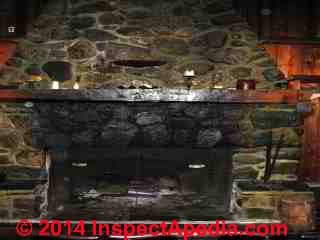
Also see STAINS on INDOOR SURFACES, PHOTO GUIDE.
Finding and fixing leaks into or onto brick structures is a cardinal stride in stopping the formation of algae, moss, efflorescence, or fungal staining on brick surfaces.
How to Remove Pigment from Brick or Stone Surfaces
Here is a summary of good practices when you lot need to remove whatever type of paint from an outside or interior brick wall, fireplace, or other surface. These methods also piece of work well for stone surfaces.
[Click to overstate any image]
Question: How do I make clean off pigment run-down from white siding on brick
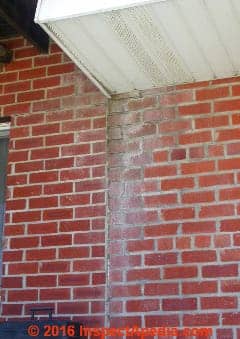
ane June 2022 dennis said:
how practise i clean paint pigment run down from white siding on brick
Reply:
Dennis,
How to Remove Paint Chalk Rundown from Brick Surfaces
If you are request merely most the simple deposits of runoff from a chalking painted surface, I recommend gentle cleaning of the brick with a natural bristle brush and a TSP substitute cleaning solution.
You can also try household detergent. Please see our warnings below almost the dangers of ambitious cleaning or power washing of brick surfaces.
Don't waste fourth dimension trying bleach every bit some of our readers did. Bleach won't remove white paint pigment and bleach itself, running downwards building surfaces can exit white streaks if not washed-off quickly plenty.
How to Remove Actual Paint or other Coatings from Brick Surfaces
Before starting, for best results in brick surface cleaning you need to know
- The kind of paint you desire to remove, every bit pigment chemistry defines what solvents work best on it - latex is unlike from alkyd or old oil-based pigment.
I experiment with soap and h2o, balmy cleaners such as vinegar, even dish soap or TSP substitute, and for some paints I might endeavor lacquer thinner, odorless paint thinner, and peel-away paint stripping coatings.
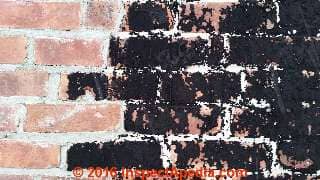
In the photo above we see thick black blanket on part of a brick outside wall of a Vassar Farm building in Poughkeepsie, NY, U.s.a..
This is tar, non paint. Nigh paint removal treatments will just brand a mess on this surface.
- The amount of paint to be removed, as a minor scale cleaning projection may have a different approach from cleaning an entire brick (or stone) surface that has been painted over.
A large surface area project is going to require drib cloths, protective gear, and probably 2 stages of chemical stripping followed by gentle brush and wash cleaning of the brick surface.
- The nature of the brick (or stone) surface - as glazed brick or hard stone is easier to clean with solvent while soft brick or soft stone such as brownstone or sandstone are at run a risk of absorbing solvent-borne pigments.
Soft brick and mortar as well blot more than water and are at greater risk of frost damage if soaked right before freezing weather.
So I don't think there is a single "right" reply that's optimum for all weather condition.
Brick Cleaning Mistakes to Avoid
Watch out: For people who are going to jump to "how to" let's first warn off some mistakes that yous'll regret:
- I'd avoid power blasting brick with sand or grit as that damages the brick, and even power washing with water can damage some brick and some mortar.
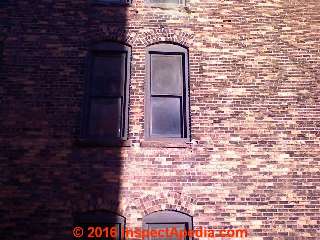
Blasting or power washing can remove the glazed surface of brick thus causing information technology to deteriorate rapidly from subsequent rain and in common cold climates frost. Much has been written warning about as well-ambitious cleaning methods on historic or older buildings, as you lot'll see in our citations below. The badly-spalling wall of this Brooklyn NY building may accept been damaged by sandblasting.
- I'd be conscientious to experiment with solvents before making a mess on the surface.
I scrape off thick coatings with a sharp scraper, and then effort scrubbing small areas of run-downwards with a toothbrush, rinsing liberally and frequently before the solvent borne paint soaks into the surrounding brick.
- Cold weather warning: I avoid soaking brick and mortar with h2o or starting any paint removal project when freezing weather condition is imminent, then at present in the bound (if yous're n of the equator) is a good time to scrub the surface using a stiff brush and the mildest solvent that works on the paint.
- I also avert muriatic acid as it's not a good paint solvent (and is dangerous to work-with). Muriatic acid is good for cleaning mortar from brick or stone surfaces as a last step when repairing or re-pointing masonry.
- Bottom line objective when removing paint from brick: avert damaging the brick such as past removing a hard glazed surface, avoid using very volatile solvents that carry pigment into the brick surface, and be very careful about personal protection from chemicals, lead, grit, etc.
Examination your stripping or cleaning procedure in a small, less-obvious area before tackling the main painted brick area.
Recommended Pigment Removers or Cleaners or Strippers for Brick or Stone Surfaces
Choose a paint removal method that suits the amount of pigment, type of pigment, and condition of the brick or stone itself. A pare abroad paint remover may likewise work on some masonry surfaces.
Try Citri-Strip for a less-toxic cleaner that may work on your paint. Newer peel-away chemical paint remover systems that apply a fabric + thick pigment-on chemical paste can pull paint off of the brick.
- Prepare the work site: Put downward vi-mil poly to take hold of paint and drippings safely while avoiding contaminating soil below the wall.
- Prepare the workers: Wear protective gear appropriate for the chemicals used.
Some paint stripping chemicals are carcinogenic, some can crusade dangerous burns or eye damage, some produce harmful VOCs and may require use of a respirator.
Old paints contain lead that can toxicant workers who don't protect against grit or fumes.
- Employ the strip or cleaning solution. If you lot are using a peel away method, basically you lot put down drop textile, coat the surface, use fabric strips, await, pare abroad the fabric that carries abroad well-nigh of the paint.
- Terminal cleanup: Wash / make clean the brick surface after the master body of paint has been removed. Even later using the pigment stripper you will probably take to do some additional gentle scrubbing on the brick surface as some pigment may remain.
- Dispose of waste: Read the disposal recommendations from the manufacturer of the chemical or paint stripper yous are using earlier starting the chore. Lead pigment chips or debris may also require special handling, wrapping, disposal.
Have a await at some of the brick cleaning references I will cite below, specially work where Grimmer was involved.
Guides for Removing Pigment & Stains from Brick Block or Stone Surfaces
- STONE, STUCCO & BRICK CLEANING METHODS - DIY cleaning methods for masonry surfaces, at InspectApedia.com
- Ashurst, Nicola. Cleaning Celebrated Buildings: V. ii: Cleaning Materials and Processes. Routledge, 2022.
- Brick Industry Association (BIA), CLEANING BRICKWORK [PDF] in Technical Notes on Brick Construction, Baronial 2022, BIA 12007 Sunrise Valley Drive, Suite 430, Reston, Virginia 20221 |United states retrieved 2022/08/16, original source: http://www.gobrick.com/docs/default-source/read-research-documents/technicalnotes/20-cleaning-brickwork.pdf www.gobrick.com | 703-620-0010
- Brick Institute of America. "Cleaning Brick Masonry." Technical Notes on Brick Structure (No. 20) rev., November, 1990.
- The Masonry Institute of America - https://world wide web.masonryinstitute.org/
- Clifton, James R., and M. Godette. "Performance tests for graffiti removers." In Cleaning Rock and Masonry. ASTM International, 1986.
- Daniels, Alva E., John R. Kominsky, and Patrick J. Clark. "Evaluation of two atomic number 82-based paint removal and waste product stabilization applied science combinations on typical outside surfaces." Journal of chancy materials 87, no. 1 (2001): 117-126.
- Grimm, Clayford T. REMOVING STAINS from BRICK [PDF] Mag. Masonry Constr. 3, no. three (1990): 117-121.
- Grimmer, Anne E. Dangers of annoying cleaning to historic buildings. [Department of the Interior], Heritage Conservation and Recreation Service [Office of Archeology and Historic Preservation], Technical Preservation Services Division, 1979.
- Grimmer, Anne East. Keeping it clean: removing exterior clay, paint, stains and graffiti from celebrated masonry buildings. DIANE Publishing, 1992.
- Liu, Katherine, and Elsa Garmire. "Pigment removal using lasers." Practical optics 34, no. 21 (1995): 4409-4415.
- Mack, Robert C., and Anne E. Grimmer. Assessing Cleaning and H2o-Repellent Treatments for Celebrated Masonry Buildings. Vol. 1. Regime Printing Office, 2000.
- United states of america GSA Removing [BROWN] Manganese Stains from Brick Masonry [PDF] U.South. General Services Assistants, retrieved 2022/12/14
- US GSA Removing Fume STAINS From BRICK MASONRY [PDF] U.S. General Services Administration, retrieved 2022/12/14
- US GSA Removing [YELLOW GREEN] Vanadium Stains from Brick Masonry [PDF] U.S. General Services Administration, retrieved 2022/12/14
Excerpt:
This process includes guidance on removing yellow or green stains from brick masonry resulting from deposits of vanadium salts on the masonry surface. B. Vanadium staining is a form of efflorescence that originates in the raw fabric used to manufacture certain brick units.It develops when wet in the wall draws salts and color from the brick composition to the surface of the masonry. As the h2o evaporates, vanadium staining is left backside.
- United states GSA Removing Dirt from BRICK MASONRY [PDF] U.Due south. Full general Services Administration, retrieved 2022/12/xiv
- US GSA CHEMICALLY REMOVING PAINT FROM and REPAINTING BRICK MASONRY [PDF] U.Southward. Full general Services Administration, retrieved 2022/12/xiv
Extract:
This procedure includes guidance on chemically removing pigment from and repainting brick masonry.NOTE: Sandblasting is not recommended by the secretary of the interior's standards for rehabilitation and shall not exist used. Loftier-pressure water blasting is also not recommended without acceptable testing or experience as information technology may erode soft brick and drive moisture into the wall.
- Usa GSA GENERAL CLEANING of EXTERIOR BRICK MASONRY [PDF] U.Southward. General Services Administration, retrieved 2022/12/14
Excerpt:
The work specified herein requires knowledge of older materials and methods and a high degree of skill to execute properly. This piece of work should be performed only past an experienced, pre-qualified contractor. It is non recommended that building maintenance personnel perform this work. - US GSA Poulticing Copper/Bronze Stains from Brick Masonry [PDF] U.S. General Services Administration, retrieved 2022/12/14
- Usa GSA POULTICING RUST STAINS FROM LIMESTONE AND MARBLE [PDF] U.S. General Services Administration, retrieved 2022/12/14
Excerpts:
This procedure includes guidance on removing rust stains from limestone and marble by poulticing using different chemical solvents or by using a paste containing a commercial rust remover.NOTE: THIS PROCEDURE MAY Too BE USED FOR REMOVING RUST STAINS FROM BRICK MASONRY.
Metallic stains from iron or steel have the appearance of rust. This type of staining is often caused by the run-offfrom flashing, gutters, statuary and fasteners. The source of the rusty runoff should be determined and cause abated. Cleaning should be undertaken after rectifying deficiencies causing the rusting.
- US GSA REMOVING SALTS / EFFLORESENCE from BRICK & Rock MASONRY [PDF] U.S. General Services Administration, retrieved 2022/12/fourteen original source: https://www.gsa.gov/ technical-procedures/ making-solution-removing-potable-soot-tar-and-other-stains-concrete?Form_Load=88552
- US GSA [PDF] U.S. Full general Services Administration, retrieved 2022/12/fourteen
- Beloin, Norman J., and Fred H. Haynie. "Soiling of building materials." Journal of the Air Pollution Command Clan 25, no. 4 (1975): 399-403.
- Brocken, Harold, and Timo G. Nijland. "White efflorescence on brick masonry and concrete masonry blocks, with special emphasis on sulfate efflorescence on concrete blocks." Construction and Building Materials xviii, no. v (2004): 315-323.
- Bryant, Terry. "Protecting Exterior Masonry from Water Damage: Moisture Command Procedures & Products." Technology & Conservation, Leap 1978, pp. 38-42.
- Cotton wool, J. Randall. "Blasted... At present What?" The Old-House Journal, January/February 1987, pp. 38-41.
- Dajnowski, A. "Laser cleaning of the Nickerson Mansion: The first building in the U.s. entirely cleaned using laser ablation." In Lasers in the Conservation of Artworks: Proceedings of the International Conference Lacona VII, Madrid, Kingdom of spain, 17-21 September 2007, vol. iii, p. 209. CRC Press, 2008.
- Grimm, Clayford T. "Don't sandblast brick." The Magazine of Masonry Construction (1990): 115-116.
- Grimmer, Anne E. Keeping it clean: removing outside dirt, pigment, stains and graffiti from historic masonry buildings. DIANE Publishing, 1992.
- Grimmer, Anne Eastward. Dangers of Abrasive Cleaning to Historic Buildings. [Department of the Interior], Heritage Conservation and Recreation Service,[Office of Archæology and Historic Preservation], Technical Preservation Services Sectionalisation, 1979.
- Grimmer, Anne E. Keeping It Clean: Removing Exterior Clay, Paint, Stains, and Graffiti from Celebrated Masonry Buildings. Washington, D.C.: U.S. Dept. of the Interior, National Park Service, Preservation Assist Sectionalization. 1988.
- Heidelmann, Hendrik. "Voruntersuchungen zum Zustand der Architekturteile und des plastischen Zierats des Sandsteinbaus der Kunstakademie Dresden." Arbeitsblätter für Restauratoren. Gruppe half dozen. Stein 27, no. 2, Gruppe 6 (1994): 313-318.
- Hocken, Jörg, and Bernd Proft. "Clean surfaces by utilization of the photocatalytic result." (2003).
- Ma, Guang-You lot, Lin-Yan He, and Xia-Fang Sheng. "Characterization of bacterial community inhabiting the surfaces of weathered bricks of Nanjing Ming city walls." Scientific discipline of the Total Environment 409, no. iv (2011): 756-762.
- Preston, John. "The surface restoration of buildings–An investment in the present every bit well every bit in the time to come." Structural Survey 7, no. 4 (1989): 450-460.
- Rozniakowski, Kazimierz, Piotr Klemm, and Agnieszka J. Klemm. "Some experimental results of light amplification by stimulated emission of radiation axle interaction with surface layer of brick." Building and Environment 36, no. 4 (2001): 485-491.
- Shahidi, Salman, Stéphane Mérillou, and Djamchid Ghazanfarpour. "Phenomenological simulation of efflorescence in brick constructions." In Proceedings of the Starting time Eurographics conference on Natural Phenomena, pp. 17-23. Eurographics Clan, 2005.
- STAINS on STONE, STUCCO DIAGNOSE & CURE
- U.S. GSA REMOVING BIOLOGICAL GROWTH FROM EXTERIOR MASONRY AND STUCCO [PDF] (2018) U.S. General Services Administration, retrieved 2022/12/14
Excerpt: This procedure includes guidance on removing biological growth such as lichens, algae, mold and mildew from masonry and stucco. B. Biological growths such as lichens, algae, moss and fungi growing on masonry walls is usually an indication that there is excess moisture in or around the masonry. These growths should be removed, as they concenter moisture to the masonry surface and concur it in that location, which tin lead to more serious problems. Lichens and mosses in particular, produce oxalic acid which tin can impairment sure types of historic masonry.
- U.S. GSA REMOVING CLIMBING PLANTS AND CREEPERS FROM MASONRY [PDF] (2018) U.Due south. General Services Assistants, retrieved 2022/12/14
Excerpt:
This process includes guidance on removing climbing plants from masonry.Information technology is important to remove heavy vegetative growth from masonry, every bit its presence tin pose many problems, such as belongings moisture against the masonry surface, blocking gutters and downspouts, scouring soft wall surfaces, eroding mortar and hindering or limiting admission for maintenance inspections and repairs.
- U.S. GSA REMOVING COPPER-BASED STAINS FROM BRICK, Physical AND LIMESTONE [PDF] (2018) U.S. Full general Services Administration, retrieved 2022/12/14
Excerpt:This specification provides guidance on removing copper staining on exterior brick, concrete and limestone.
Remove soiling, stains and crusts from the limestone and granite without damaging underlying material and to give all stone a clean, uniform appearance without blotches, streaks or other irregularities. Use the gentlest means to meet the cleaning objective.
If the exterior masonry has been previously subjected to inappropriately harsh and uneven cleaning, it is expected that the cleaning will reveal the original colors and textures of the brick, but that it volition non completely correct the differential effects of the previous cleaning. Clean brick to remove soiling, stains and crusts to the extent viable without farther damaging the brick.
- U.S. GSA REMOVAL OF FERROUS STAINING FROM BRICK, GRANITE, Concrete AND LIMESTONE [PDF] (2018) U.S. General Services Administration, retrieved 2022/12/14
Excerpt:This procedure includes guidance on removing ferrous staining from exterior brick, concrete and limestone surfaces.
Remove soiling, stains and crusts from the limestone and granite without dissentious underlying material and to give all stone a clean, compatible appearance without blotches, streaks or other irregularities. Apply the gentlest means to come across the cleaning objective.
If the exterior masonry has been previously subjected to inappropriately harsh and uneven cleaning, it is expected that the cleaning will reveal the original colors and textures of the brick, only that information technology volition non completely correct the differential furnishings of the previous cleaning. Clean brick to remove soiling, stains and crusts to the extent feasible without further damaging the brick.
- U.Due south. GSA REMOVING PAINTED GRAFFITI FROM MASONRY [PDF] (2018) U.Southward. Full general Services Assistants, retrieved 2022/12/14
Excerpt:
This process includes guidance on removing painted graffiti from historic masonry (this includes spray paint and paint-based felt-tipped markers).Successful removal of graffiti from masonry is dependent upon the type and surface texture of the masonry as well equally the particular substance applied.
Reader Q&A - also meet the FAQs series linked-to below
 It would exist expected that over its life some of the brickwork on a century-quondam building has been re-built, particularly over that door lintel, also in areas prone to h2o impairment;
Moisture seeping into brick will frequently produce a white effloresence; so we'll see at least three brick colours and may on closer inspection come across differences in the mortar mix or even tooling details at the mortar joints - supporting an understanding of the building's history.
Night brownish or black stains I run into in an area below the patio wall / apartment roof parapet wall are ofttimes algae or on occasion, a mold that's invited where there has been extra wetness - peradventure from a leaky parpet capstone covering.
You lot volition want to exist sure that there are no leaks into the wall structure particularly from the patio roof above. Very often when we see white stains on brick is efflorescence from moisture. You can read about that in this article serial.
[Click to enlarge whatsoever image]
The edifice is in Utrecht, the Netherlands and was built effectually 1900-1920. Indeed the meridian left corner seems as if were totally unlike brick.
The stain I consider the darker patch around 2m loftier and it seems to exist getting a petty lighter towards the lesser (color matches the residuum of the building there).
Could very well be simply some unfortunate pick of placing different colored bricks.
It was built 100 year ago approx.
Delight experience free to post it. I believe asking a builder to make clean the brick would not hurt even if information technology would resolve the deviation in color.
Perhaps I'll try to get some brick friendly plants/English ivy.
[Click to overstate any epitome]
 Ok now, which is the area that y'all are because the stain? the darker brick, or the whiter brick?
It looks as if a portion of the wall has been re-congenital.
Where is this building and what is its age?
What is the history of repairs to the surface of the patio-roof?
It is a roof terrace. I'll attempt and get you lot more pictures. On the indoor on the ground floor is the bathroom but I did non see dampness in that location. It also was renovated recently.
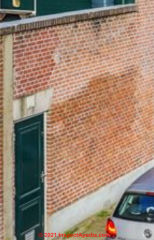 I run across
- nighttime stains just below a wall top coping that looks like a roof parapet wall
- areas where mortar is more than-white than others
- areas of more than-red brick over a door, probably a repair or reconstruction
- area of redder brick below whiter brick that may besides be an area of prior repairs.
I would need some more photo showing more of the building, at a distance so I can go some perspective in context, also what's above, is that a flat roof?
Hi! I can't effigy out why there'due south a discoloration on the brick of my house I just bought. [Photo above]
Thanks
Eva
I promise you are keeping well in these strange times! I wonder if you lot accept an idea why the below brick wall is discolored (if helpful, on the within it'south a recently renovated bathroom). Is in that location any way to fix it ?
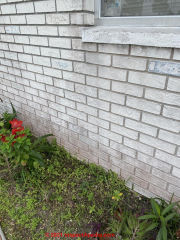 @MC,
@MC,
The most probable crusade of the discoloration of brick on your veneer wall shut to the ground is rain splash-upwardly, acquired, in plow by spillage of water from the roof border.
The proper solution, if that's the example is to brand sure that the gutters are cleaned and properly sloped and draining away from the house and not spilling over into that area.
When you've taken care of that it would make sense to make clean the brick surface and if the paint has really come off of the brick then y'all'll demand to repaint the bricks.
I take a brick face up facade on my home. I believe it has a white wash finish.
In that location are ruby brownish stains on it. When it gets moisture, you lot can literally see a what appears the cherry-red brick from underneath. I would like to apply sealer merely fearful that the cherry colour of brick will stay permanently on the surface.
Is in that location annihilation I can do for remedying the staining and waterproofing it somehow so that there is no discoloration when it gets wet ?
Try gentle brushing with vinegar or other household cleaners; rinse thoroughly
A hibiscus bush with big cherry-red flowers greww nest to a newly painted white brick wall, I tried to remove the dried leaves with a sponse and water and information technology let i calorie-free dark-green stain. How tin i remove the stain so the brick will return to white color
That is weird, David. Effort attaching a sharp photo or several (i per comment)
I have a weird issue on the outer brick wall of my house. It is a articulate substance--completely transparent--that looks like very sparse melted plastic adhering in irregular patterns, virtually like it was dripped and pooled in random patterns.
At kickoff I thought maybe a pocket-size clear piece of plastic had melted on the bricks--but then more than of the stuff showed up later on the previous spots had started to fade
. I'm pretty sure no one is deliberately doing it in the dark. So far my best guess is perhaps some kind of pollen or sap is being diddled and splattered occasionally on that wall. Haven't establish it on any other wall. I am really perplexed equally to what it might be. Any thoughts?
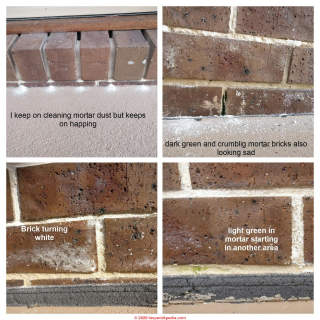 Marie
Marie
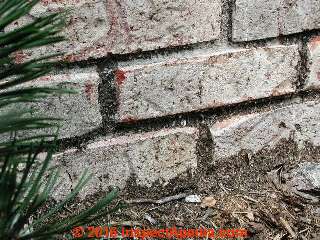
Thank you for the interesting photos and question about mortar deterioration in your brick veneer wall.
I think we accept a combination of leaks into the wall
(meet those openings in the mortar joints in your photo at summit left?)
and maybe variations in the mortar mix.
Beginning by finding and sealing leaks into the veneer wall.
Why simply in a couple of surface area of our home but both under cover do i take the mortar turning to grit and in some places turning dark-green.
Also a brick is turning white.
Delight assist, How tin I care for this.
There are several commercial iron-stain removers such as Iron-Out that may work. Endeavor first in an unobtrusive spot.
Iron water stain on brick(gunkhole house). What is the safest chemical and environmentally friendly with plants past the wall?
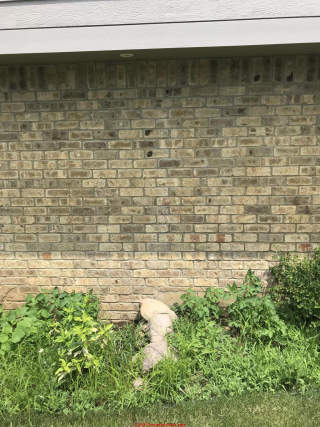
Liz
Later on cleaning off the soot or creosote,
and having the flue inspected for burn-condom,
be sure the chimney is alpine enough - 2 ft. above the ridge or 2 ft in a higher place bespeak of contact with roof surface of a horizontal line drawn from chimney meridian to bear upon the nearest roof surface;
Ask your chimney sweep if your chimney has the correct type of cap - preventing downdrafts;
I'm reluctant to rely on a larger cap since we'll simply motion the stain from the chimney to the roof surface, and so nosotros're left with taking care to burn dry, low-sap wood at sufficient temperature.
How tin can I preclude a black stain on the exterior of my house only below the chimney I take a wood burning stove
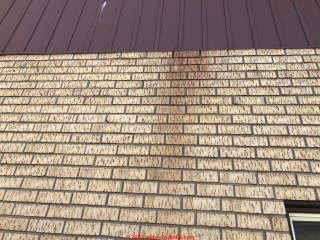 Gabriel
Ii approaches to removing the reddish stain on your brick are
ane. try some masonry cleaners or iron removers every bit discussed in the article above
2. check out the list of probable causes of red stains on brick - too in the article above - to see if, past narrowing down the probable crusade of the carmine stains in your photo nosotros can dwelling house in on the most-effective cleaner
3. inspect the building, rooftop to siding bottom, including interior, plumbing, mechanical systems, to find the leak or defect that is causing this stain to appear in this item location.
In my view this is an of import pace as otherwise nosotros don't know that the stain isn't but a telltale of a more-serious subconscious problem.
It seems that my aluminum siding has run into my bricks. Not certain if information technology's rust or just the siding color. Hi do I safely have off without compromising the brick color?
Cheers
Hello, information technology seems that my brown aluminium siding is running down on my bricks. I'k not sure if it's rust or merely the color of the siding. Whatever suggestions how to take it off without compromising the color of the bricks
...
Continue reading at STONE, STUCCO & BRICK CLEANING METHODS for cleaning approaches useful for brick or rock surfaces, or select a topic from the closely-related manufactures below, or see the complete ARTICLE INDEX.
Or run into STAINS on BRICK SURFACES FAQs - questions and answers posted originally on this page.
Or come across these
Stone & Masonry Stains & Cleaning Articles
- CHIMNEY STAINS & LEAKS
- CHIMNEY STAINS, INDOORS
- EFFLORESCENCE SALTS & WHITE DEPOSITS
- MASONRY CLEANERS
- MOLD Advent - STUFF THAT IS NOT MOLD for other discolouration establish on brick surfaces.
- STAIN DIAGNOSIS on Building EXTERIORS - home
- STAINS on BRICK SURFACES
- STAINS on Concrete
- STAINS on INDOOR SURFACES, PHOTO GUIDE
- STAINS on SANDSTONE, DIAGNOSE & CURE
- STAINS on Rock, STUCCO DIAGNOSE & CURE
- STONE, STUCCO & BRICK CLEANING METHODS
- STONE SURFACE CLEANING & ORGANIC GROWTH PREVENTION (Algae, Fungus, Lichens, Moss) from Rock, Brick, or Concrete Surface
Suggested citation for this web page
STAINS on BRICK SURFACES at InspectApedia.com - online encyclopedia of building & environmental inspection, testing, diagnosis, repair, & problem prevention advice.
Or see this
Index to RELATED ARTICLES: Article INDEX to BUILDING STAINS
Or utilise the SEARCH BOX constitute below to Ask a Question or Search InspectApedia
...
Ask a Question or Search InspectApedia
Try the search box just below, or if you adopt, postal service a question or comment in the Comments box below and nosotros volition answer promptly.
Search the InspectApedia website
Notation: appearance of your Annotate beneath may be delayed: if your comment contains an image, web link, or text that looks to the software as if it might be a web link, your posting will announced later on information technology has been canonical past a moderator. Apologies for the delay.
Technical Reviewers & References
Click to Show or Hide Citations & References
Publisher InspectApedia.com - Daniel Friedman

Source: https://inspectapedia.com/exterior/Stains_on_Brick.php
Posted by: bowershavocapiente.blogspot.com
0 Response to "How To Clean Oil From Concrete Crc Electric Lean"
Post a Comment